



By Miriam Humbe
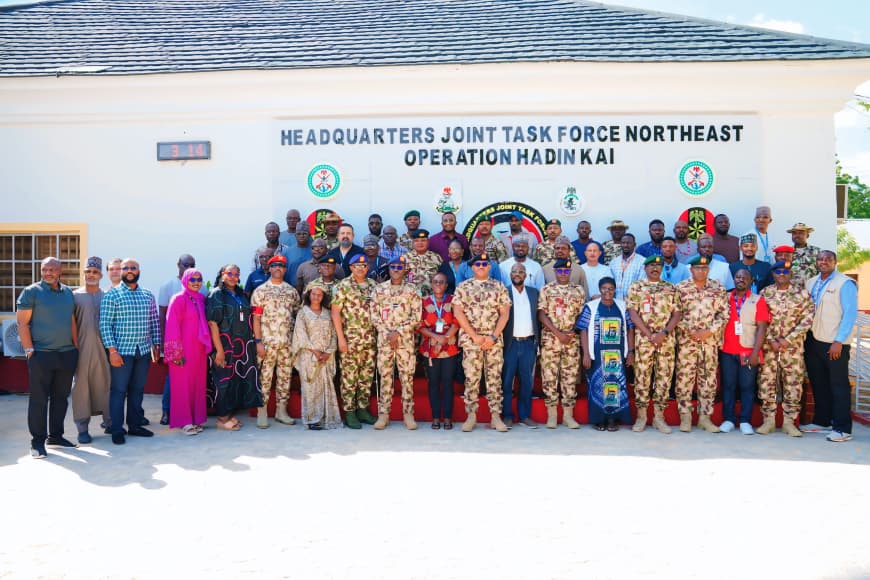
In its continuing efforts to strengthen collaboration and partnership for enhanced Protection of Civilians in the North East, Headquarters Joint Task Force (North East) Operation HADIN KAI (OPHK), in partnership with the United Nations Office for the Coordination of Humanitarian Affairs (UN OCHA), hosted a Humanitarian/Civil-Military Coordination Roundtable on Thursday, 13 August 2026.
Captain Mohammed Goni, the Acting Military Information Officer
Headquarters Joint Task Force (North East) Operation HADIN KAI disclosed this in a statement signed on Thursday.
The Roundtable is a forum designed to foster more efficient and effective delivery of humanitarian assistance to vulnerable communities affected by armed conflict across Borno, Adamawa and Yobe States.
The event, aimed at strengthening professional ties and enhancing cooperation on key regional security and humanitarian challenges, brought together representatives of various humanitarian agencies, the Borno State Government and other relevant stakeholders at the Headquarters OPHK Conference Room.
The Roundtable was co-chaired by the Theatre Commander OPHK, Major General AE Abubakar and the Deputy Head of Office UN OCHA, North East Nigeria, Patricia Mucheche.
During the engagement, participants received comprehensive briefings on the humanitarian activities and stabilisation efforts of Operation HADIN KAI, setting the tone for robust deliberations on critical issues affecting humanitarian operations.
The discussions featured comments, suggestions and recommendations aimed at improving coordination, facilitating humanitarian access and supporting more effective assistance to conflict-affected communities.
In his keynote address and opening remarks, the Theatre Commander welcomed participants to the roundtable, describing the engagement as timely and important to strengthening partnership and constructive dialogue between Operation HADIN KAI and the humanitarian community under the auspices of UN OCHA.
He noted that the meeting, held four years after the last Humanitarian Roundtable, was aligned with the Chief of Army Staff’s directive to reinforce the Armed Forces of Nigeria’s commitment to humanitarian support.
Major General Abubakar emphasised that while kinetic operations remain essential to degrading the residual capabilities of terrorist groups, the Humanitarian Line of Effort is equally indispensable, stressing that the protection of civilians, facilitation of safe returns and restoration of socio-economic activities cannot be achieved through military means alone.
Major General Abubakar identified key areas requiring strengthened coordination, including securing major humanitarian supply routes, protecting civilians and recently relocated IDPs, safeguarding farmers and livelihood activities, addressing misconducts and strengthening the relationship between the Armed Forces and humanitarian partners.
He also acknowledged challenges affecting humanitarian operations, including IED threats, movement of large volumes of cash, access constraints, security of humanitarian actors and assets, as well as funding limitations, while calling for open, respectful and constructive dialogue to address these concerns.
He expressed appreciation to UN OCHA, humanitarian partners and the International Committee of the Red Cross for their continued support to affected communities and capacity-building initiatives for OPHK personnel.
The engagement also reflects the broader commitment of the Nigerian Army to facilitating safe and unhindered humanitarian access in conflict-affected areas.
The Chief of Army Staff, Lieutenant General Waidi Shaibu, had earlier reaffirmed the Nigerian Army’s sustained commitment to providing the security necessary for the safe movement of humanitarian personnel, relief materials and critical supplies, particularly along key operational corridors.
He emphasised that safe humanitarian access remains central to civilian protection, stabilisation and the safe and dignified return of displaced persons to their communities.
The COAS stressed the need for innovative force protection measures, robust convoy escort arrangements and stronger operational coordination between the military and humanitarian organisations, while encouraging UN OCHA to strengthen forward logistics planning to sustain uninterrupted humanitarian assistance despite prevailing funding constraints.
In her opening remarks, the Deputy Head of Office (North East), UN OCHA, acknowledged the organisation’s collaboration with the military, highlighting its vital role in ensuring the safe delivery of humanitarian assistance to communities across North East Nigeria.
She underscored the significance of the Roundtable as a platform for military and humanitarian partners to engage in practical discussions aimed at improving programme implementation and strengthening humanitarian response.
She called for enhanced patrols along major supply routes.
She also highlighted the threat posed by Unexploded Ordnance and emphasised the need to protect communities to which Internally Displaced Persons have been relocated, stressing that protection of civilians remains central to the humanitarian response.
The Deputy Theatre Commander, Joint Task Force North East, Operation HADIN KAI, Air Vice Marshal OF Akinboyewa, thanked participants for the frank and constructive engagement, stressing that discussions on humanitarian access, freedom of movement along major supply routes, protection of farmers, civilians and returning displaced persons directly affect the ability of communities to return home, pursue livelihoods and rebuild their lives safely.
He noted that sustained military operations continue to degrade the capacity of JAS and ISWAP and expand the security space for humanitarian action, stabilisation and restoration of normal life, while emphasising that military success must ultimately be measured by the extent to which citizens can live, move and pursue their livelihoods without fear.
He reaffirmed Operation HADIN KAI’s commitment to securing critical routes and population centres, protecting civilian livelihoods, strengthening oversight and discipline among hybrid forces, and maintaining a predictable and responsive coordination framework with humanitarian partners based on trust, timely information and mutual respect.
He further assured that the concerns and recommendations raised at the roundtable would be carefully considered and followed through.
He stressed that the collective aspiration remains a transition from emergency assistance to recovery, resilience and sustainable development, with Operation HADIN KAI committed to deepening its partnership with the humanitarian community towards restoring stability, dignity and normalcy across the North East.
