



By Miriam Humbe
Nigeria’s Defence and security institutions have been urged by the Civil Society Legislative Advocacy Centre, CISLAC, and Transparency International Nigeria to urgently dismantle barriers holding women back and to build reporting systems that protect victims of sexual and gender-based violence.
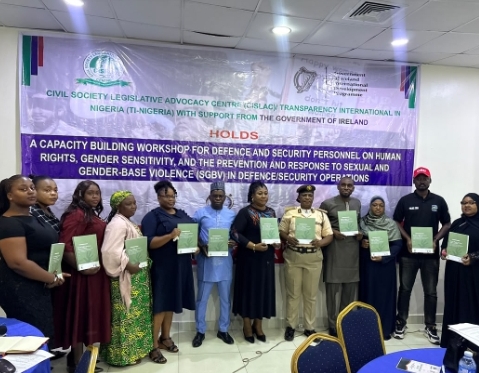
CISLAC/TI-Nigeria made the call in Abuja at the end of a capacity-building workshop
with support from the Government of Ireland.
Executive Director, CISLAC/TI-Nigeria, Auwal Ibrahim Musa Rafsanjani and Maurice Chukwu, Researcher, Amnesty International Nigeria disclosed this in a communique jointly signed by them.
The workshop was attended by officers from the Military, Police and other security agencies as well as officials from the Ministries of Defence, Interior and Women Affairs.
The National Human Rights Commission, ICPC, NDLEA, civil society organisations, women’s rights groups and the media also attended.
CISLAC Executive Director, Comrade Auwal Ibrahim Musa Rafsanjani, delivered the welcome address.
A key moment was the launch of CISLAC’s validated baseline assessment report titled _“Human Rights Practices, Patterns of SGBV and the Effectiveness of Existing Complaint and Accountability Mechanisms Within Defence and Security Agencies.”
Mrs Ngozi Okore, Director of Women and Children at NHRC, launched the report on behalf of the NHRC Executive Secretary, Chief Anthony Ojukwu. The document lays bare patterns of abuse and the gaps in how complaints are handled across security agencies.
CISLAC said the report was not meant to indict, but to guide reform. According to Rafsanjani, security institutions cannot claim professionalism while ignoring issues of gender inequality and abuse within their ranks.
During group discussions, participants zeroed in on three areas: getting more women into leadership, making SGBV reporting safe and confidential, and identifying the operational habits that enable abuse.
The findings were blunt. Women in uniform still struggle with promotion and appointment because of stereotypes and a workplace culture that does not prioritise gender fairness.
CISLAC also noted the danger of unequal power relations. When a junior officer’s career depends on a senior’s recommendation, it creates room for intimidation, harassment and exploitation.
Another major concern raised was the state of reporting. Participants told CISLAC that most existing channels are not confidential, and many personnel do not trust them. That fear of victimisation keeps many cases buried.
The workshop further observed poor supervision during night duties and field work, inadequate accommodation for female officers, and search procedures that sometimes exclude female personnel.
Checkpoints and operational spaces where officers interact with civilians were flagged as risk areas. CISLAC warned that without monitoring, these spaces can become avenues for exploitation, especially against women.
On accountability, the report noted delays in investigations and weak disciplinary follow-up. It also pointed to limited access to healthcare, legal support and safe shelter for survivors, which discourages reporting.
To fix this, CISLAC recommended a full review of recruitment, promotion and deployment policies to remove gender discrimination. It wants clear targets for women in leadership and the strengthening of Gender Advisers and Gender Focal Persons in every agency.
The organisation also called for mandatory gender and cultural sensitivity training for all personnel, plus mentorship programmes to help women rise through the ranks.
For reporting, CISLAC proposed dedicated hotlines, secure emails, complaint boxes and digital platforms. Gender Desks must be properly staffed, and investigations must follow clear timelines with female officers included where appropriate.
On prevention, CISLAC urged agencies to conduct SGBV risk assessments before and during operations, enforce unannounced supervision, and ensure separate accommodation and restrooms during deployments.
For survivors, CISLAC wants referral directories linking victims to medical, legal and psychosocial support. It also stressed collaboration with NHRC, civil society and health providers, and the need for safe shelter for those at risk.
In its closing, CISLAC said the workshop must translate into action plans with timelines and focal persons in each agency. Rafsanjani insisted that human rights and gender standards must be reflected in daily operations, not just in policy document.
