



By Miriam Humbe
Comptroller-General of the Nigeria Customs Service (NCS), Bashir Adewale Adeniyi, has said that a more professional, accountable and technology-driven Customs Police Unit (CPU) was highly needed in order to tackle emerging security threats, combat illicit trade and strengthen the integrity of the Service.
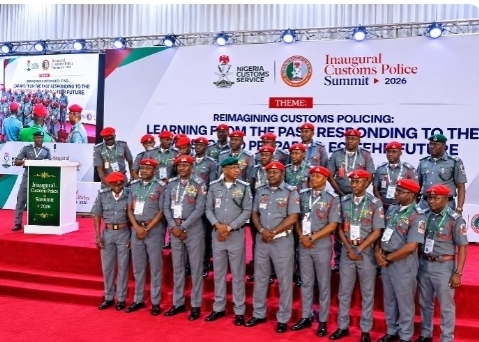
CGC Adeniyi said this on Thursday at the inaugural Customs Police Summit, 2026 event which held in Abuja.
The summit was themed: “Reimagining Customs Policing: Learning From The Past, Responding To The Present, And Preparing For The Future”.
CGC Adeniyi said the summit was an opportunity to review the evolution of Customs policing, address operational challenges and develop strategies for building a more effective unit capable of responding to changing security realities.
He therefore, identified three major lessons from the evolution of the unit.
Adeniyi said: “Our history teaches three lessons. First, charity begins at home. Before we demand integrity from traders and the public, we must show it ourselves. Second, authority requires restraint.
“The NCS Act 2023 gives us police powers, but every search, arrest and detention must rest on lawful grounds and withstand public and judicial scrutiny.
“Third, enforcement in isolation fails. Coordinated initiatives such as the One-Stop Shop have shown that enforcement and facilitation work best together. Criminal networks have grown more sophisticated.
“They use the same routes as legitimate traders to move firearm components, narcotics, fake medicines, protected wildlife and illicit funds, often through digital channels.
“Our answer must be smarter, not harder. WCO instruments such as the SAFE Framework, the Authorised Economic Operator programme, advance rulings, the Time Release Study and the Revised Kyoto Convention reward compliance and free officers to focus on real risk.”
CGC Adeniyi said that integrity must begin within the Service, authority exercised with great restraint, and enforcement must be supported by effective collaboration.
He said that the Customs Police Unit was established in 2019 with a clear mandate to investigate misconduct among personnel, prevent crime and ensure compliance with established standards.
He revealed that the Nigeria Customs Service Act 2023 provided the Service with law enforcement powers, but that such authority must be exercised in accordance with the law.
He said: “Every search, arrest and detention must rest on lawful grounds and must withstand public and judicial scrutiny”.
CGC Adeniyi said there was the need for stronger partnerships with law enforcement agencies such as the Nigeria Police Force, Armed Forces, National Drug Law Enforcement Agency (NDLEA), National Agency for Food and Drug Administration and Control (NAFDAC), Department of State Services (DSS) and Independent Corrupt Practices and Other Related Offences Commission (ICPC), among others.
He said innovation would require the deployment of artificial intelligence, advanced scanners, digital investigation tools and electronic cargo tracking to improve intelligence-led operations.
Adeniyi identified data as one of the Service’s most valuable assets.
He said access to global criminal databases and reliable information-sharing platforms were vital to strengthening investigations and improving operational efficiency and called for responsible use of technology.
He stressed that innovation must remain subject to legal safeguards, data protection and human oversight and urged officers to uphold discipline, professionalism and respect for human rights, warning that misconduct and abuse of authority could undermine public confidence and damage the reputation of the Service.
He also commended officers who had contributed to the development of the Customs Police Unit.
CGC Adeniyi and urged them to preserve established standards while identifying areas requiring improvement.
Speaking earlier, convener of the event, Provost Marshal of the Service, Deputy Comptroller General of Customs, TS Sanusi said professional standards, compliance and effective governance were key in strengthening Customs policing.
Sanusi said the Service must continue to align its enforcement activities with international best practices, particularly in promoting transparency, accountability, ethical conduct, risk management and anti-corruption measures.
Also in an earlier address, Assistant Comptroller-General of Customs, ACG Shuaibu, said the Customs Police Unit was a critical asset to national security, internal discipline, specialised criminal administration, compliance monitoring and the protection of the Service’s institutional reputation.
He outlined the Unit’s responsibilities to include enforcing regulations, investigating misconduct, ensuring the dignified treatment of suspects, protecting officers and promoting professionalism and accountability.
Shuaibu said the Unit must strengthen its operational framework, improve intelligence gathering and embrace modern surveillance, risk analysis and investigation techniques to address increasingly sophisticated criminal activities and called for stronger internal controls, impartial investigations and consistent enforcement of disciplinary standards.
He reminded officers to exercise their powers with fairness, restraint and respect for human rights.
The Economic and Financial Crimes Commission (EFCC) representative stressed the need for investment in personnel, technology and leadership to prepare law enforcement institutions for emerging challenges.
He urged the Nigeria Customs and other paramilitary agencies to strengthen supervisory structures, ensure lawful conduct and address misconduct consistently, regardless of the rank or position of those involved.
He also highlighted the importance of emotional intelligence, personnel welfare, crisis management and effective conflict resolution in improving the performance of law enforcement officers.
Highlights of the event were the presentation of souvenirs to dignitaries and a group photograph.
The event was attended by officers of the Nigeria Customs Service, Nigerian Navy, the Nigerian Army, NSCDC, EFCC, other Security agencies, stakeholders and the media.
