


By Miriam Humbe
Disciplined operations, appropriate controls, clear accountability and continuous monitoring, and listening to our customers and using their experiences to improve how we deliver these services are important.
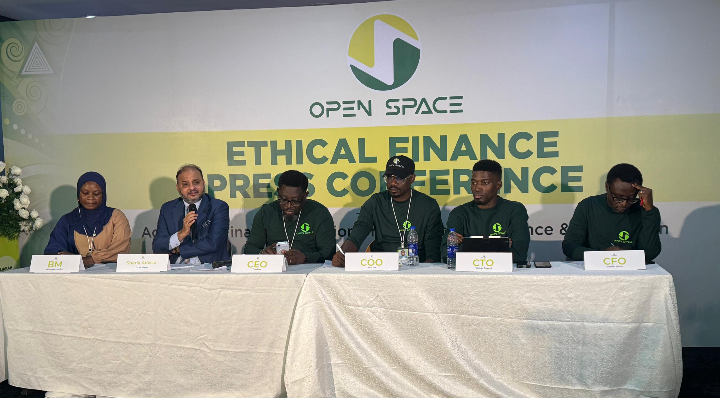
Oscar Ede, the Chief Operating Officer, Open Space disclosed this during the press conference on the launch of Ethical Finance on Tuesday in Abuja.
The founders of Open Space believe that technology is so important to the future of Ethical Finance, it exists within an intelligent financial ecosystem where financial services and Artificial Intelligence are brought together.
Ede said: “Ultimately, our measure of success will not be how sophisticated our structures appear on paper.
“It will be whether a customer can access the right financial solution, understand the relationship they are entering, receive the service they were promised and feel confident that Open Space is managing that relationship responsibly.
“Ethical Finance must therefore be experienced, not merely explained.
“Today, as we launch Ethical Finance, my commitment on behalf of the operations team is that we will remain focused on making the principles of fairness, transparency, responsibility and trust tangible in the way we serve our customers.
“We are building an operating environment where innovation is matched by discipline, where growth is matched by accountability, and where financial solutions are designed to work not only in theory, but in the everyday lives and businesses of the people we serve.”
Titus Adakole Ikeh, the Chief Executive Officer of Open Space said the launch was the unveiling of an important expression of what Open Space believe finance can and should become when technology, innovation and human purpose are brought together deliberately.
The CEO said while these solutions are Shariah compliant and provide an important alternative for customers who specifically seek such financial structures, the underlying principles speak to a much broader human need.
He said: “At Open Space, our vision has always been to put human lives at the centre of financial and social innovation.
“We set out to build an ecosystem that can make financial services more accessible, intelligent, relevant and meaningful to people, particularly those who have historically remained underserved or excluded from the formal financial system.”
Ikeh said fairness, transparency, accountability and trust are not merely concepts associated with Ethical Finance.
He said: “They are values that sit at the heart of the kind of institution we want Open Space to become.
“For me, the most compelling aspect of Ethical Finance is that it challenges us to think differently about what financial value means and how it should be created.
“It moves the conversation beyond simply asking how much capital can be provided and towards asking how capital can be deployed responsibly, transparently and in ways that create genuine economic value.”
Ololade Otayemi, the Chief Technology Officer at Open Space said the launch was a demonstration of what becomes possible when ethical financial structures are supported by modern technology, intelligent systems and a carefully designed digital infrastructure.
Otayemi said: “At Open Space, we do not see technology as simply a channel through which financial services are delivered. We see it as an intelligence layer that can make financial services more responsive to people, more transparent in their operation and more efficient in the way decisions and transactions are managed.
“This is why Artificial Intelligence and Machine Learning are fundamental to our broader technology vision. Our platform is being designed to use AI and ML to understand financial behaviour, support personalised experiences, improve decision-making and help users manage their finances with greater clarity and control.”
The Shariah Advisor for Open Space, Zubair Mughal in a presentation titled: Islamic/Ethical Finance: A Promising Pathway For Nigeria’s Inclusive Financial Future said the global Islamic/Ethical banking and finance industry has moved from a niche faith-based alternative to a mainstream component of the international financial system.
Mughal said that across Africa, Islamic/Ethical banking and finance is increasingly relevant as governments, regulators, banks, fintech companies, development institutions, and investors search for financing models that can support infrastructure, SMEs, agriculture, housing, trade, and financial inclusion.
He said: “The continent has a large unbanked and underbanked population, and many individuals and businesses remain outside formal finance due to cost, access, trust, or preference for ethical and non-interest-based financial services. Islamic/Ethical finance can help bridge this gap by offering asset-backed banking, Sukuk, Takaful, microfinance, leasing, partnership-based financing, and fintech-enabled solutions that are connected to real economic activity.
“Nigeria is one of the most important markets for Islamic/Ethical banking and finance in Africa.
“With its large population, strong entrepreneurial base, deepening capital market, and growing demand for non-interest financial products, Nigeria has the potential to become a leading Islamic/Ethical finance hub in West Africa.”
